
Views: 0 Author: Site Editor Publish Time: 2026-04-10 Origin: Site


Nitric acid is an important industrial chemical with the formula HNO₃. It is widely used in fertilizers, explosives, metal treatment, and chemical manufacturing. When people ask where nitric acid comes from, the answer has two parts. In nature, nitric acid can form in the atmosphere through reactions involving nitrogen oxides, oxygen, and water. In modern industry, however, most nitric acid is produced from ammonia through the Ostwald process, which remains the principal manufacturing method today.
Understanding both origins is useful because natural nitric acid formation explains its role in air chemistry and acid rain, while industrial nitric acid production explains how the world obtains the large volumes needed for commercial use. For almost all practical business and manufacturing purposes, the nitric acid sold on the market comes from controlled industrial production, not from natural collection.
In the natural environment, nitric acid forms in the atmosphere. One important route begins when nitrogen and oxygen react under high-temperature conditions, such as lightning or other intense energy events, producing nitrogen oxides. These oxides can then undergo further reactions in air and moisture, eventually contributing to the formation of nitric acid. Britannica notes that nitric oxide can be formed from nitrogen and oxygen by electric sparks or high temperatures, and that nitric oxide in the atmosphere can combine with water vapor to form nitric acid.
This natural pathway is part of broader atmospheric chemistry. Once formed, nitric acid may enter rainwater and become part of what is commonly described as acid rain. That means nitric acid is not only an industrial product but also a chemical species that can appear naturally in the environment under the right conditions.
Still, natural formation is relatively limited compared with industrial demand. Nature may produce nitric acid in the atmosphere, but not in the large, concentrated, commercially useful quantities required for fertilizer plants, chemical factories, or export supply chains. That is why industrial manufacturing became essential.
For modern industry, nitric acid mainly comes from ammonia. The principal manufacturing route is the Ostwald process, developed by Wilhelm Ostwald in the early twentieth century. In this process, ammonia gas is oxidized first to nitric oxide, then to nitrogen dioxide, and finally the nitrogen dioxide is absorbed in water to produce nitric acid. Britannica describes this as the principal method of nitric acid manufacture and notes that the resulting acid-in-water solution is typically about 50–70 percent by weight acid.
The overall industrial logic is straightforward. The process starts with ammonia as the main feedstock, uses air or oxygen for oxidation, and then uses water to form nitric acid from the oxidized nitrogen compounds. A platinum or platinum-rhodium catalyst is used to support the oxidation steps efficiently. This controlled, large-scale route is what makes commercial nitric acid production possible.
Because the process is highly standardized and scalable, it became the dominant industrial method. That is why when buyers source nitric acid today, they are almost always purchasing product ultimately made from ammonia through this catalytic oxidation route.
To understand where nitric acid comes from in industry, it also helps to look at its main raw materials.
Ammonia is the key feedstock. It provides the nitrogen that is transformed step by step into nitric oxide, nitrogen dioxide, and finally nitric acid. Britannica explicitly identifies catalytic oxidation of ammonia as the principal manufacturing method for nitric acid.
Air, or in some systems oxygen, is needed for the oxidation reactions. Without this oxygen supply, ammonia cannot be converted into the nitrogen oxides required for nitric acid production.
Water is used in the final absorption stage, where nitrogen dioxide is converted into nitric acid solution. This is why commercial nitric acid is commonly sold as an acid-in-water solution rather than as pure anhydrous acid.
So in practical industrial terms, nitric acid comes from a combination of ammonia, air, water, and catalytic process control.
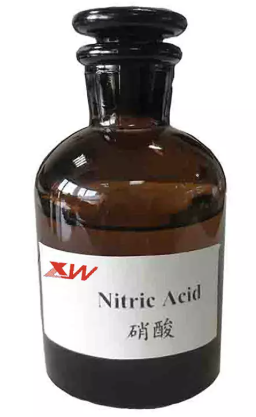
Before modern industry adopted the Ostwald process, nitric acid was prepared in other ways. Britannica notes that a common older laboratory method involved heating potassium nitrate with concentrated sulfuric acid, a process associated with Johann Rudolf Glauber in the seventeenth century. Chemistry references also note that nitric acid can be removed by distillation in such systems because of the different boiling points involved.
This older method was important historically, but it was not suitable for the scale required by modern agriculture and industry. As demand for fertilizers, explosives, and chemical intermediates increased, the Ostwald process replaced older preparation methods because it was more efficient and better suited to large-scale production.
Nitric acid is also connected to the larger movement of nitrogen through the environment. Atmospheric nitrogen oxides can be transformed into nitric acid, and that nitric acid can then reach soil and water through precipitation. In this sense, nitric acid is part of environmental nitrogen chemistry as well as industrial chemistry.
However, the nitric acid found in nature is not the same as the commercial nitric acid supply chain. Environmental formation is diffuse and low-concentration, while industrial nitric acid is produced in controlled plants at known concentration and purity. That distinction is important for buyers, students, and industrial users alike.
Modern industry produces nitric acid at large scale because it is a key raw material in several major sectors. Britannica identifies nitric acid as important for the production of ammonium nitrate fertilizer, explosives such as nitroglycerin and TNT, and for oxidizing metals. These uses explain why large-scale nitric acid production is necessary.
In other words, nitric acid does not come from industry by accident. It is produced on purpose, in large volume, because it supports essential manufacturing chains across agriculture, mining, metal processing, and chemical synthesis.
It is useful to separate the idea of natural nitric acid from commercial nitric acid.
Natural nitric acid forms in the atmosphere from nitrogen oxides and water, often with lightning or pollution-related chemistry playing a role. Commercial nitric acid, by contrast, is produced in plants from ammonia using catalytic oxidation and water absorption.
The difference is not only in origin, but also in scale, concentration, and control. Natural nitric acid is part of environmental chemistry. Commercial nitric acid is a manufactured product with specified concentration, packaging, and quality requirements. For industrial users, the second meaning is the one that matters most.
At Shijiazhuang Xinlongwei Chemical Co., Ltd., we understand that nitric acid is more than a chemical formula. It is an important industrial product that depends on stable concentration, reliable packaging, and professional supply support. By providing dependable service for nitric acid HNO₃, we help customers meet a wide range of industrial and commercial needs.
So, where does nitric acid come from? In nature, it can form in the atmosphere when nitrogen oxides react with oxygen and water, including under conditions influenced by lightning and air pollution. In industry, most nitric acid comes from ammonia through the Ostwald process, where ammonia is oxidized to nitric oxide and nitrogen dioxide, and then converted into nitric acid in water.
The clearest practical answer is this: commercial nitric acid HNO₃ mainly comes from industrial production, not natural collection. Natural formation helps explain nitric acid in the environment, but the nitric acid used in fertilizers, explosives, metal treatment, and chemical manufacturing is overwhelmingly made in controlled industrial systems.
Where does nitric acid come from naturally?
Nitric acid can form naturally in the atmosphere when nitrogen oxides react with oxygen and water. Lightning and atmospheric reactions are part of this process.
How is nitric acid made in industry?
Most industrial nitric acid is produced from ammonia through the Ostwald process. In this method, ammonia is oxidized to nitric oxide, then to nitrogen dioxide, and finally absorbed in water to form nitric acid.
What raw materials are used to make nitric acid HNO₃?
The main raw materials are ammonia, air or oxygen, and water. These are combined in a controlled catalytic process to produce nitric acid HNO₃.
Does nitric acid come from nature or factories?
Both, but in different ways. Nitric acid can form naturally in the atmosphere, while the nitric acid used in commercial and industrial applications mainly comes from factory production.
Why is the Ostwald process important?
The Ostwald process is important because it is the main industrial method used to produce nitric acid efficiently and at large scale for fertilizers, explosives, and chemical manufacturing.
Is natural nitric acid the same as commercial nitric acid?
They are the same chemical in principle, but natural nitric acid forms in small, diffuse amounts in the atmosphere, while commercial nitric acid is produced in controlled concentrations for industrial use.


